Value Creation Model

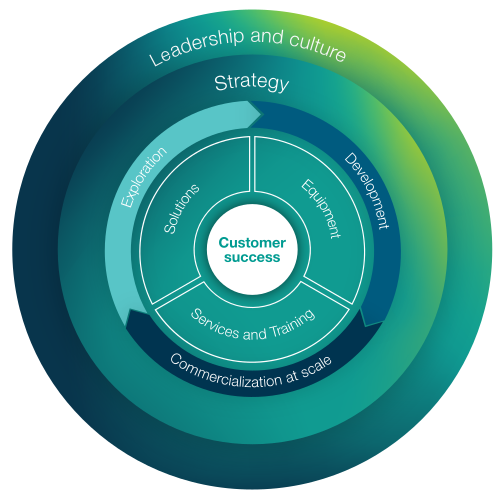
The Value Creation Model illustrates how Bühler creates value for customers, employees, bondholders, business partners, and owners by unlocking sustainable business opportunities in the global food, feed, and advanced materials industries. It shows how we seek to balance humanity, nature, and economy in every decision and how this translates into outcomes for wider society and the environment.

People make the difference. We add leadership excellence to engineering excellence, entrepreneurship, and our extensive ecosystem, and increase everyone’s agility and ability to adapt and thrive. 
By contributing to the success of our customers, we enable our profitable growth, while balancing humanity, nature, and economy. 
We spend 5% of revenue on R&D every year, aligned directly with our strategy and sustainability goals.   
We develop technological solutions and at our Application & Training Centers we work with customers to develop the next generation of their processes and products. 
We enable customers to scale new processes to be production ready  and provide industrial infrastructure and technology to grow their business. 
This comprises Bühler's plants all over the world.
This encompasses Bühler's Single Machine Business.
Bühler Services deliver customer success across the whole asset cycle.

Inputs Economy

131 mCHF

R&D expenses

59 mCHF

Investments into asset base

Outputs Economy

2.8 bCHF

Turnover

220 mCHF

EBIT

712 mCHF

Net liquidity

54.7 %

Equity ratio

Inputs Nature

587,700 GJ

Energy consumption

365,977

Water withdrawn

35,868 tonnes

Raw materials¹

Outputs Nature

17,151 tonnes

Waste generated

717,657 tonnes

CO₂e emissions in our operations²

319 tonnes

CO₂e / MWh energy savings per plant³

Inputs Humanity

12,092

Full-time equivalent (FTE) employees

524

Apprentices

24

Diversity, Equity & Inclusion workshops held

Outputs Humanity

0.96

Work-related injuries (total recordable incident rate per 100 full-time workers)

67 %

Percentage of apprentices in Switzerland hired after completing apprenticeship

479

Diversity, Equity & Inclusion workshops attendance

410 million tonnes of CO₂e/year

– avoided emissions due to yield and energy optimization per wheat mill.⁴

12

– number of solutions that contribute to land use reduction, side stream utilization, and circularity

1.5 million tonnes

– new storage capacity for grain installed.

680,000

– water saved in malting process through Bühler technologies.

175,000 tonnes

– plant-based meat analogues produced on Bühler lines in 2025.

12,900 tonnes of CO₂e/year

– avoided emissions from heating and cooling due to coated architectural glass.⁵

1,333 tonnes of CO₂e

– emissions saved due to material circularity in remanufacturing of die-casting machines.

Outcomes

Inputs Economy

131 mCHF

R&D expenses

59 mCHF

Investments into asset base

Inputs Nature

587,700 GJ

Energy consumption

365,977

Water withdrawn

35,868 tonnes

Raw materials¹

Inputs Humanity

12,092

Full-time equivalent (FTE) employees

524

Apprentices

24

Diversity, Equity & Inclusion workshops held

Outputs Economy

2.8 bCHF

Turnover

220 mCHF

EBIT

712 mCHF

Net liquidity

54.7 %

Equity ratio

Outputs Nature

17,151 tonnes

Waste generated

717,657 tonnes

CO₂e emissions in our operations²

319 tonnes

CO₂e / MWh energy savings per plant³

Outputs Humanity

0.96

Work-related injuries (total recordable incident rate per 100 full-time workers)

67 %

Percentage of apprentices in Switzerland hired after completing apprenticeship

479

Diversity, Equity & Inclusion workshops attendance

Outcomes

410 million tonnes of CO₂e/year

– avoided emissions due to yield and energy optimization per wheat mill.⁴

12

– number of solutions that contribute to land use reduction, side stream utilization, and circularity

1.5 million tonnes

– new storage capacity for grain installed.

680,000

– water saved in malting process through Bühler technologies.

175,000 tonnes

– plant-based meat analogues produced on Bühler lines in 2025.

12,900 tonnes of CO₂e/year

– avoided emissions from heating and cooling due to coated architectural glass.⁵

1,333 tonnes of CO₂e

– emissions saved due to material circularity in remanufacturing of die-casting machines.

  • Natural capital
    This includes resources such as water, fossil fuels, solar energy, crops and carbon sinks, which cannot be replaced and are essential to the functioning of the economy as a whole.
  • Human capital
    The skills and know-how of an organization's personnel, in addition to their commitment and motivation that affects their ability to fulfill their role.
  • Social and relationship capital
    This encompasses the relationships – and attendant resources – between an organization and all its stakeholders, including communities, governments, suppliers and customers.
  • Manufactured capital
    This encompasses physical infrastructure or technology pertaining to this, such as equipment and tools.
  • Intellectual capital
    This accounts for the intangibles associated with brand and reputation, in addition to patents, copyrights, organizational systems and related procedures.
  • Financial capital
    The traditional yardstick of performance, this capital includes funds obtained through financing or generated by means of productivity.
People make the difference. We add leadership excellence to engineering excellence, entrepreneurship, and our extensive ecosystem, and increase everyone’s agility and ability to adapt and thrive. 
By contributing to the success of our customers, we enable our profitable growth, while balancing humanity, nature, and economy. 
We spend 5% of revenue on R&D every year, aligned directly with our strategy and sustainability goals.   
We develop technological solutions and at our Application & Training Centers we work with customers to develop the next generation of their processes and products. 
We enable customers to scale new processes to be production ready  and provide industrial infrastructure and technology to grow their business. 
This comprises Bühler's plants all over the world.
This encompasses Bühler's Single Machine Business.
Bühler Services deliver customer success across the whole asset cycle.
Outcomes
410 million tonnes of CO₂e/year

– avoided emissions due to yield and energy optimization per wheat mill.⁴

12

– number of solutions that contribute to land use reduction, side stream utilization, and circularity

1.5 million tonnes

– new storage capacity for grain installed.

680,000

– water saved in malting process through Bühler technologies.

175,000 tonnes

– plant-based meat analogues produced on Bühler lines in 2025.

12,900 tonnes of CO₂e/year

– avoided emissions from heating and cooling due to coated architectural glass.⁵

1,333 tonnes of CO₂e

– emissions saved due to material circularity in remanufacturing of die-casting machines.

Inputs Economy

131 mCHF

R&D expenses

59 mCHF

Investments into asset base

Outputs Economy

2.8 bCHF

Turnover

220 mCHF

EBIT

712 mCHF

Net liquidity

54.7 %

Equity ratio

Inputs Nature

587,700 GJ

Energy consumption

365,977

Water withdrawn

35,868 tonnes

Raw materials¹

Outputs Nature

17,151 tonnes

Waste generated

717,657 tonnes

CO₂e emissions in our operations²

319 tonnes

CO₂e / MWh energy savings per plant³

Inputs Humanity

12,092

Full-time equivalent (FTE) employees

524

Apprentices

24

Diversity, Equity & Inclusion workshops held

Outputs Humanity

0.96

Work-related injuries (total recordable incident rate per 100 full-time workers)

67 %

Percentage of apprentices in Switzerland hired after completing apprenticeship

479

Diversity, Equity & Inclusion workshops attendance

This includes resources such as water, fossil fuels, solar energy, crops and carbon sinks, which cannot be replaced and are essential to the functioning of the economy as a whole. }
The skills and know-how of an organization's personnel, in addition to their commitment and motivation that affects their ability to fulfill their role. }
This encompasses the relationships – and attendant resources – between an organization and all its stakeholders, including communities, governments, suppliers and customers. }
This encompasses physical infrastructure or technology pertaining to this, such as equipment and tools. }
This accounts for the intangibles associated with brand and reputation, in addition to patents, copyrights, organizational systems and related procedures. }
The traditional yardstick of performance, this capital includes funds obtained through financing or generated by means of productivity. }
 
1. Excluding semi-processed and equipment materials.
2. Scopes 1, 2, and selected Scope 3 categories.
3. Compared to 2019.
4. E3 mill with smart mill vs mill from 2017; yearly savings due to 10% energy reduction and 1% yield. increase for one plant with average throughput of 135,000 tonnes per year.
5.Double Insulating Glass Unit (IGU) with low emissivity coating compared to IGU without such a coating.

contact block

Do you have a question? Contact our Media Relations team.


Gupfenstrasse 5
Uzwil
9240
Switzerland